How to become a chief finance officer (CFO)
Manage and coordinate the overall financial and accounting operations within companies and organisations.
Pathways to this career
Complete an accredited undergraduate degree in finance, accounting, economics or business.
Complete a Master of Business Administration (MBA) or the Certified Public Accountant (CPA) examination.
Work your way up in companies and gain extensive work experience in leadership roles within the financial departments.
Depending on the size of the company, achieving CFO level can take a minimum of 10 years or more, so work hard and don’t give up.
What does a CFO do?
An organisation’s CFO is the senior executive responsible all finance activities. This can include financial records, financial reporting, and compliance. CFOs must have excellent management skills and extensive experience with creating and managing budgets and financial resources.
Duties and tasks
Use financial reports to inform recommendations for business strategy.
Develop long-term profit projections, budgets and financial positions.
Devise, monitor, and evaluate financial strategies, including comprehensive budgeting and accounting, and policies for practices.
Evaluate and authorise operational project budgets and financial proposals.
Implement policies and procedures for accounting methods and monitor activities.
Provide ongoing analysis of funding source reliability, investment strategies, and financial allocations.
Research relevant legislation and regulations pertaining to financial practices and ensure activities are in compliance.
Industry bodies
Related jobs
Management consultant
Treasurer
Discover finance courses online

UndergraduateGRF-BUS-DEG
Get the professional skills employers are looking for
Learn how organisations work and visualise where you fit in. Get familiar with financial documents, risk, and business comms. This business course gives you a 360-degree view of business strategy. Specialisations include marketing and management.
- Study method
- 100% online
- Duration
- 3 years full time or part time equivalent
- Entry requirements
- No ATAR required. Start with a subject.
Available majors
- Marketing,
- Human Resource Management,
- Management,
- Innovation and Entrepreneurship,
- Sport Management,
- Logistics and Supply Chain Management,
- International Business,
- Political Science and International Relations,
- Contemporary Marketing,
- Strategic Communication (second major only)

Master of Business Administration
PostgraduateCUR-ADM-MAS
Make an investment in your career by choosing an MBA
Propel your career forward with a foundation in contemporary business theory, centred on innovation and strategy. Designed for managers who want to lead, engage with a variety of perspectives, within a framework of sustainable governance practices.
- Study method
- 100% online
- Duration
- Approx. 1.5 years full time or part time equivalent
Bachelor of Commerce (Business Law)
UndergraduateCUR-BLW-DEG
Solve contemporary business problems using your knowledge of the law
Examine how law is applied to business by understanding torts, property, trusts, trade practices, company and contract law, taxation, industrial and intellectual property law. Graduates excel in roles in both business and government.
- Study method
- 100% online
- Duration
- 3 years full time or part time equivalent
- Entry requirements
- No ATAR required. Start with a subject.

Undergraduate Certificate of Business
UndergraduateSWI-BUS-CTF
Start here for a career in business
Explore core concepts in business. In just 6 months, you’ll build communication skills and start thinking strategically. Choose from marketing, management, and other electives. Gain credit for your studies and think about a future in business.
- Study method
- 100% online
- Duration
- 6 months full time or part time equivalent
Need help making study choices for your career?

Need help making study choices for your career?
Our student advisors will turn your aspirations into a clear study path.
They'll help you with:
Choosing and enrolling in the right course for your desired career, including pathway options.
Mapping a study plan that allows you to balance work and home commitments.
Understanding eligibility for funding, including HECS-HELP loans.
Get unbiased advice at no cost today.
Looking for other ways to start the conversation? Contact us
Step up your career with these resources
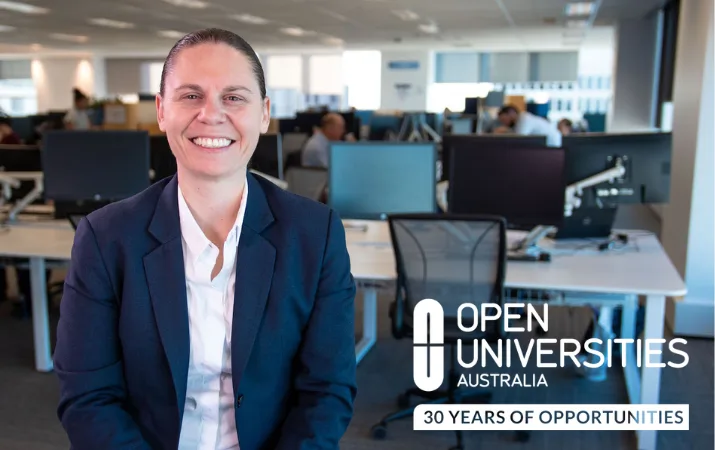
Louise reflects on her career, as we reflect on 30 years
Welcome to our 30 Years Series, a chance to reflect on the achievements of students in the 30 years since Open Universities Australia began. Today, you’ll hear from Executive MBA graduate, Louise Howard.

Business management vs business administration: What should you study?
Thinking about enrolling in one of these business specialisations? Let’s explore which option is your best fit.

Career planning: What can you do with an MBA?
There are so many ways you can use a Master of Business Administration to get ahead in your career, and they aren’t just in the business world. Let’s look at what else is out there.

How hard is an MBA?
Thinking about getting your MBA, but not sure if you're up for the workload? Here are the main things to know before enrolling, from two students who've been there.